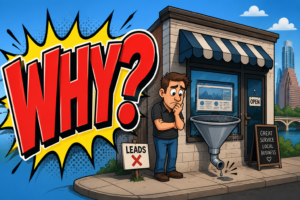
If you own a small business in Austin, Texas, there’s a good chance you already have a website.
Maybe you paid someone a few thousand dollars to build it.
Maybe your cousin helped you set it up.
Maybe you used a template and spent an entire weekend figuring out fonts, colors, and buttons.
And yet…
The phone barely rings.
The contact forms stay empty.
The site gets visitors, but nobody becomes a customer.
Sound familiar?
You’re not alone. A lot of small business websites in Austin look good on the surface but quietly fail at doing the one thing they’re supposed to do:
Generate leads.
The truth is, having a website is not the same as having a website that converts. And in a fast-growing, highly competitive city like Austin, that difference matters more than ever.
Let’s talk about why so many small business websites struggle to bring in real customers, and what actually works instead.
Austin Is Growing Fast… and So Is the Competition
Austin isn’t the same city it was 10 years ago.
New businesses pop up every day. More people are moving here. More companies are fighting for attention online. Whether you run a roofing company in Round Rock, a med spa in South Austin, a cleaning business in Cedar Park, or a local furniture repair service, your customers have options.
A lot of options.
When someone searches for a service online, they’re comparing businesses within seconds. If your website doesn’t immediately build trust or guide visitors toward taking action, they leave.
Usually without saying a word.
And the hardest part?
Most business owners don’t even realize it’s happening.
Problem #1: The Website Looks Nice… But Says Nothing
This is one of the biggest mistakes small businesses make.
The homepage has:
- A stock photo
- A generic headline
- A paragraph nobody reads
- And maybe a “Learn More” button
But after 10 seconds on the site, visitors still don’t know:
- What you actually do
- Who you help
- Why they should choose you
- Or how to contact you quickly
Here’s the reality:
People in Austin are busy. They’re scrolling fast. They don’t want to “figure out” your business.
Your website should instantly answer:
- What service do you offer?
- What area do you serve?
- Why are you trustworthy?
- What should visitors do next?
If your homepage feels vague or overly corporate, people bounce.
Fast.
Problem #2: No Clear Call-to-Action
A surprising number of websites never actually ask visitors to do anything.
No strong contact button.
No quote form.
No “Call Now.”
No easy next step.
It’s like opening a store and never greeting customers.
A good website should guide people naturally.
For example:
- “Get a Free Estimate”
- “Book Your Cleaning Today”
- “Call Our Austin Team”
- “Schedule a Consultation”
Simple works.
Most small businesses overcomplicate their websites because they think more information equals more trust. In reality, clarity converts better than clutter.
Problem #3: Slow Websites Kill Leads
Austin customers expect speed.
If your website takes forever to load, people leave before they even see your services.
This happens more than business owners realize, especially with:
- oversized images
- cheap hosting
- outdated themes
- too many animations
- bloated plugins
A slow website doesn’t just frustrate visitors, it also hurts your Google rankings.
That means fewer people find your business in the first place.
And honestly? Most people won’t wait around for a slow site anymore. Attention spans are short, especially on mobile.
Problem #4: The Site Isn’t Built for Mobile Users
This is huge.
Most local customers in Austin search from their phones.
They’re looking for services while:
- sitting in traffic on I-35
- drinking coffee downtown
- at work
- or relaxing at home
If your website is difficult to use on mobile, you’re losing leads every single day.
Common issues include:
- tiny text
- buttons too small to click
- forms that are annoying to fill out
- menus that don’t work properly
- pages that look broken on phones
A mobile-friendly website isn’t optional anymore. It’s the standard.
Problem #5: There’s No Local SEO Strategy
A beautiful website means very little if nobody can find it.
A lot of Austin small businesses launch a website and assume customers will magically appear.
Unfortunately, that’s not how it works.
Your website needs local SEO if you want visibility in searches like:
- “best plumber in Austin”
- “Austin furniture repair”
- “roofing company near me”
- “deep cleaning services Austin TX”
Without local optimization, your competitors show up instead of you.
Good local SEO includes:
- Austin-focused service pages
- optimized Google Business Profile
- local keywords
- fast-loading pages
- reviews
- proper page titles and meta descriptions
- location-based content
Google wants to recommend businesses that clearly serve the area people are searching in.
If your site barely mentions Austin or surrounding areas, you’re making it harder for search engines to understand your business.
Problem #6: No Trust Signals
People are cautious online.
Especially when hiring local services.
If your website doesn’t build trust quickly, visitors hesitate.
And hesitation usually means they leave.
Strong trust signals include:
- real customer reviews
- before-and-after photos
- local testimonials
- project galleries
- team photos
- certifications
- guarantees
- years in business
- clear contact information
Ironically, many small businesses in Austin do amazing work but fail to showcase it online.
Your website should feel human.
Not robotic.
Not generic.
Not like every other template online.
People want to hire businesses they feel comfortable with.
Problem #7: The Website Was Built for the Owner, Not the Customer
This happens all the time.
Business owners focus on what they want to say instead of what customers need to hear.
Visitors don’t care about:
- fancy wording
- complicated mission statements
- buzzwords
- or long paragraphs about “innovation”
They care about solving a problem.
For example:
- Can you fix my furniture?
- Can you clean my house?
- Can you repair my roof?
- Can you help my business grow?
Your website should make those answers obvious.
The best-performing websites are usually the simplest.
Problem #8: Nobody Maintains the Website
A website is not a “set it and forget it” tool.
But many small businesses treat it that way.
Outdated websites create problems like:
- broken forms
- old phone numbers
- expired promotions
- security issues
- poor rankings
- slow performance
Even worse, outdated websites make businesses look inactive.
Imagine visiting a website that still says:
“Happy New Year 2022!”
That instantly lowers trust.
Regular updates matter more than people think.
What Actually Makes a Website Generate Leads?
Now for the good news.
You do not need the fanciest website in Austin to generate leads.
You just need a website that works.
The best lead-generating websites usually do a few things really well:
They’re clear
Visitors immediately understand the business.
They load fast
No waiting around.
They work perfectly on phones
Because that’s where most traffic comes from.
They build trust
Reviews, photos, testimonials, and real branding.
They make contacting the business easy
Calls, forms, buttons, and quotes are simple.
They target local customers
Austin-focused SEO and content.
They feel human
Not corporate or robotic.
That’s it.
Simple beats complicated almost every time.
Small Businesses in Austin Don’t Need Bigger Websites, They Need Smarter Ones
A lot of business owners think the solution is adding:
- more pages
- more graphics
- more animations
- more text
But most of the time, the real issue is strategy.
Your website should function like your best salesperson:
- available 24/7
- easy to talk to
- trustworthy
- helpful
- and focused on converting visitors into customers
When done correctly, even a simple website can consistently bring in leads every month.
Final Thoughts
Austin is one of the best cities in the country for small businesses right now. But it’s also becoming more competitive online every year.
If your website isn’t generating leads, it doesn’t necessarily mean your business is the problem.
More often than not, the website simply isn’t designed to convert visitors into customers.
The good news is that most of these problems are fixable.
Sometimes small changes make a massive difference:
- clearer messaging
- better mobile design
- faster speed
- stronger local SEO
- easier contact options
- more trust-building content
At the end of the day, your website should do more than just “exist.”
It should help your Austin business grow.
Because in today’s world, your website is often the first impression people have of your company, and first impressions happen fast.